From the Shore to the Screen: Building Digital Resilience in Bangladesh’s Coastal Fishing Communities

Bridging the gap between traditional marine life and the digital world. A community-led initiative supported by Monash University.

Contact Us

From PhD Research to Community Action

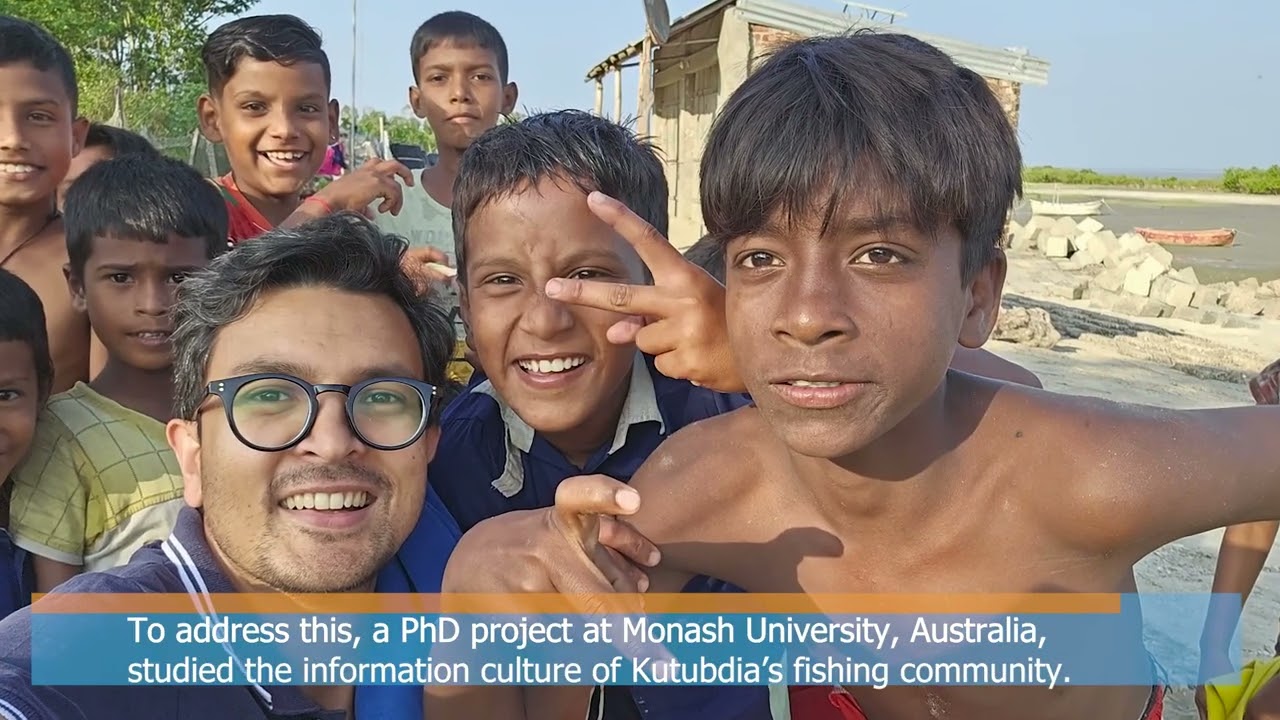
This initiative grew directly from the findings of a PhD research project in the Faculty of Information Technology at Monash University. The research explored the information culture of small-scale marine fishing communities on an island in Bangladesh, focusing on how community members access, share, evaluate, and use digital information in their everyday lives. It examined the social, cultural, and structural factors that shape their engagement with technology and online information.

With support from the Equity, Diversity, and Inclusion (EDI) School Outreach Fund at Monash University, the project has moved beyond research into action. Today, we work alongside the community to build practical digital literacy skills and strengthen safe information interactions. Our goal is to equip community members with the tools and knowledge they need to navigate digital information safely — enabling them to benefit from online opportunities while recognising and avoiding potential risks. This project is about turning research insights into meaningful, community-led impact.

The Challenge: Why Digital Literacy Matters Here

The internet offers new opportunities — from weather updates and market prices to government services and communication tools. However, without digital literacy, engaging with online information can create serious risks for fishing communities.

1 Misinformation and Rumours

Unverified news and rumours spread rapidly through social media platforms. Without the skills to distinguish credible information from unreliable ones, community members may make critical decisions — about weather, safety, or health — based on misleading or false information, with potentially dangerous consequences.

2 Online Scams and Financial Fraud

Fraudulent schemes targeting vulnerable populations are increasingly common online. From fake loan offers to deceptive investment opportunities, those with limited digital literacy are far more likely to fall victim to financial scams that can devastate already fragile household incomes.

3 Health Misinformation

False health advice circulates widely across messaging apps and social media. Without the ability to verify medical information, community members may rely on harmful remedies or ignore legitimate health guidance, putting themselves and their families at serious risk.

4 Unsafe Social Media Use

Uncritical sharing of information can spread rumours, create conflict, or expose individuals to exploitation and harassment.

5 Privacy and Data Exploitation

Many people are unaware of how their personal data is collected and used online. Without digital literacy, community members may unknowingly share sensitive personal information, leaving them exposed to identity theft, manipulation, or exploitation.

6 Harmful and Extremist Content

Without the ability to critically assess online content, individuals — particularly young people — may be exposed to harmful, misleading, or extremist material that can influence beliefs, behaviour, and community wellbeing.

7 Dependence Without Empowerment

Access to smartphones and the internet does not automatically lead to empowerment. Without critical skills, users may consume information passively rather than using it confidently and strategically.

8 Exclusion from Digital Services

Government services, disaster alerts, and financial tools are increasingly digital. Without the ability to navigate these platforms safely and effectively, community members risk further marginalisation.

Community Context: Life on the Island

Understanding the traditional flow of knowledge to build better digital networks.

How Information Flows

In this small-scale marine fishing community, information has traditionally flowed through physical sources: neighbors, the Sardar, the Imam, and local tea shops. Today, digital sources are mixing with these traditional voices.

The Digital Anchor

To bridge this gap, our program encourages the identification of local "digital anchors"—trusted individuals within the community who can help others authenticate digital information and understand online content.

Recent Activities

Documenting our journey of fieldwork, community engagement, and pilot training on the ground.

03 Dec 2025
Event photo 1
Event photo 2
Event photo 3
Event photo 4
Event photo 5
Event photo 6
Event photo 7
Event photo 8

Focus Groups: Consultation with Fishermen and Women

On 3 December 2025, researchers visited a fishing community to better understand how people access and manage the information needed in their daily lives. Community members shared several challenges. Many children leave school early due to weak educational opportunities and often join fishing activities at a young age. Although fishermen may earn income during productive seasons, limited awareness about financial management and online risks sometimes makes them vulnerable to scams.

Fishermen also noted that much of their free time is spent at tea stalls, where people gather to chat but have few opportunities to engage with useful or reliable information. Community members expressed a strong interest in creating a shared space where they could access information, discuss community issues, and learn how to identify trustworthy sources. They also wanted a safe and supportive environment where their children could spend time reading and learning, as many parents hope their children will pursue safer careers than fishing.

Following these discussions, the researchers and community members chose a location for the shared learning space. One fisherman generously offered the front yard of his home, which is now being used as a community space where people can gather, learn, and engage more critically with information.

24 Jan 2026
Event photo 1
Event photo 2

Fieldwork: Planning the Community Library

On 24 January 2026, the team returned to the fishing village for a follow-up meeting to plan the construction of a community library as a shared learning space. During this visit, researchers and community members discussed possible locations and alternative options for establishing the space beyond the previously proposed front yard of a fisherman's house. Local builders and villagers considered constructing a strong tin-roofed structure that could withstand the harsh coastal winds. However, the estimated cost of building such a structure was far beyond the available budget.

The team explored more affordable alternatives, but community members explained that cheaper materials would not survive the local weather conditions. It soon became clear that reducing costs would mean compromising the durability of the structure. Given these constraints, the community and researchers confirmed the decision to begin the community library in a fisherman's yard. Although small, this space represents an important first step toward their shared vision of creating a lasting centre for learning and community development.

25 Jan 2026
Event photo 1
Event photo 2
Event photo 3
Event photo 4
Event photo 5

Pilot Training in the Shared Learning Space

On 25 January 2026, the team conducted a pilot training session with local fishermen on the basics of internet safety. The purpose of the session was to gather feedback on the training manual and better understand the community's learning needs. At the beginning of the session, many participants believed the internet was largely harmless. Through simple examples and discussions, the trainers explained that online spaces can involve risks—much like situations in everyday life.

Participants learned practical ways to stay safe online, including creating strong passwords and recognising common online scams. The training explained that passwords act like locks protecting personal information, and weak or repeated passwords can make users vulnerable to hackers. The session also introduced different types of scams, such as fake offers, impersonation attempts, and emotional manipulation (including romance scams). Participants were advised not to click on suspicious links, share personal information, or send money to unknown individuals.

By the end of the session, many fishermen expressed greater awareness and caution about online activities. What began as a basic introduction turned into an eye-opening experience, helping participants take their first steps toward safer and more informed internet use. Participants also reported that the training was easy to understand, and they found the shared learning space convenient for gathering and learning together. However, they suggested that the space would benefit from basic logistical support, such as tables, chairs, and a board for teaching.

Meet the Team

Dedicated researchers and strategists driving the Coastal Connect initiative forward.

Joy Bhowmik

Joy Bhowmik

PhD Candidate, Monash University

Joy Bhowmik is an interdisciplinary researcher whose work spans information science, environmental science, and sustainable development. His PhD research examines how marginalised communities access, share, evaluate, and use information, and how cultural values, social norms, and social structures shape everyday information interactions. With extensive experience in teaching, research, and international collaboration, Joy is committed to connecting people with the resources and information they need to make meaningful changes in their communities, strengthening climate resilience and digital inclusion. His work combines qualitative social science approaches with information studies to design culturally appropriate digital and information strategies that support equitable and inclusive development. Joy has over a decade of professional experience working on sustainable development across Bangladesh, Germany, and international contexts. He has contributed to projects and consultancies with organisations including the International Labour Organisation (ILO), Oxfam, USAID, and Winrock International, focusing on climate adaptation, gender equity, community resilience, and economic empowerment.

Dr. MD. Khalid Hossain

Dr. MD. Khalid Hossain

Research Fellow, Department of Human Centred Computing

Dr. Hossain works as a Research Fellow at the Department of Human Centred Computing of the Faculty of Information Technology. He is responsible for carrying out independent and/or team research on community informatics and environmental informatics. He has more than eighteen years of professional experience which includes his roles as Programme Coordinator at IUCN Bangladesh, Economic Justice and Resilience Programme Manager at Oxfam in Bangladesh, Head of Climate Change Programmes and Project Coordinator (Climate Change Unit) at CCDB, Campaign Coordinator and Policy Officer at Oxfam GB – Bangladesh.

Dr. Gillian Oliver

Dr. Gillian Oliver

Adjunct Professor, Department of Human-Centred Computing

Dr. Oliver is an Adjunct Professor in the Department of Human-Centred Computing within the Faculty of Information Technology at Monash University. She is a founding Co-Director of the Information Empowered Communities Lab and served as Principal Investigator for PROTIC II. Dr. Oliver’s multidisciplinary research is strongly focused on real-world impact, establishing strong collaborations with First Nations and Indigenous communities. She led the Whyte Bequest–funded Indigenous Data Sovereignty & Living Archives initiative and has served in significant academic leadership roles.

Dr. Viviane Frings

Dr. Viviane Frings

Senior Lecturer & Co-Director, Information Empowered Communities Lab

Dr. Frings is a Senior Lecturer and Co-Director of the Information Empowered Communities Lab in the Faculty of Information Technology at Monash University. She is the lead for PROTIC III, an interdisciplinary project on Indigenous Data Sovereignty on the Global South. Her research focuses on the preservation of information and on recordkeeping as a tool to empower marginalised communities. She was the recipient of a DECRA Fellowship (2021-2024) to support her research on the information access and preservation needs of marginalised rural communities in Bangladesh.

Wais Kafia Chowdhury

Wais Kafia Chowdhury

Undergraduate Student, Computer Science and Engineering, BRAC University

Wais Kafia Chowdhury is an undergraduate student in Computer Science and Engineering at BRAC University. His academic interests lie at the intersection of computer science, digital systems, and emerging technologies, with a particular focus on how technological innovation can contribute to social and economic development in developing countries. His studies explore areas such as software development, web technologies, and digital infrastructure, alongside an interest in the broader societal implications of technology adoption. Through academic coursework and independent projects, he has developed experience in designing and implementing digital platforms and practical technology-driven solutions. Wais is particularly interested in the role of technology in enabling digital transformation and improving access to information and services within communities. His long-term academic goal is to pursue advanced research that bridges technological development with societal needs, contributing to sustainable and inclusive digital progress.

Md. Shamim Hossain

Md. Shamim Hossain

Media Studies & Journalism Student, University of Liberal Arts Bangladesh

Md. Shamim Hossain is a final-year undergraduate student in Media Studies and Journalism at the University of Liberal Arts Bangladesh (ULAB). His academic and professional interests focus on digital journalism, development communication, and multimedia storytelling. He is passionate about using media as a tool to raise awareness, amplify marginalized voices, and contribute to sustainable social change. Shamim has gained practical experience working as a correspondent for Daily Shomoyer Alo, where he reported on regional issues and developed strong engagement with local communities. In addition, he plays an active role at ULAB TV as a reporter and Head of HR and News HR, contributing to news production, scriptwriting, voiceover, and organizational development. His work spans television reporting, mobile journalism (MOJO), program production, and live news coverage. Recognized for his contributions, he has received multiple awards from ULAB TV, including Best Program Producer and Best News Assistant Reporter. Shamim's research and professional interests lie in exploring the evolving landscape of digital media and its impact on society, particularly in the context of developing countries. He aims to build a career that integrates journalism, communication strategy, and social impact.

Documentation

Watch our field documentation capturing the initiative's journey within the community.

Documentary Video Thumbnail
Click to play

Contact Us

For additional information and to explore collaboration opportunities regarding this initiative, please feel free to contact:

✉ Joy.bhowmikk@gmail.com